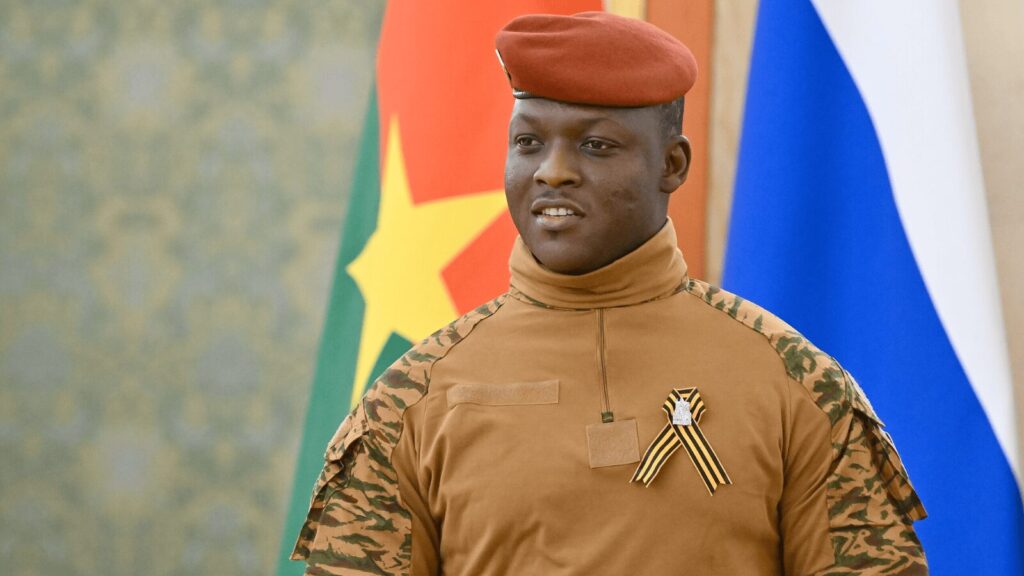
Photo: President of Burkina Faso Ibrahim Traore in Russia for a meeting with Vladimir Putin, by Stanislav Krasilnikov. [This article was originally published by Pambazuka News on September 19, 2025.]

In a time of both global uncertainty and the revived assertion of regional identity, I find myself returning frequently to one burning question: Is Pan-Africanism still alive? For decades, opponents viewed the movement as an outdated post-independence philosophy from the utopian dream buried alongside leaders like Kwame Nkrumah, Thomas Sankara, and Patrice Lumumba.
But today, as I watch the political landscape shift, especially in West Africa, I’m convinced the answer is yes. Pan-Africanism lives—and it is being reborn through its youth. Among the new vanguard stands Ibrahim Traoré, the 36-year-old president of Burkina Faso, whose rise signals a reawakening of Pan-Africanism in the heart of Africa’s youth.
The Legacy of Pan-Africanism
Early in the 20th century pan-Africanism developed in response to colonialism and the exploitation of African people and resources. With a view toward independence, solidarity, and liberation from foreign powers, it demanded the unity of all African states and peoples—on the continent as well as in the diaspora.
Leaders like Nkrumah of Ghana and Sankara of Burkina Faso championed these ideals during the post-independence wave of the 1960s and 1980s. However, the Pan-African vision darkened as political instability, economic crises, and neocolonial interventions seized hold. Leaders such as Lumumba were assassinated, Nkrumah was overthrown in a Western-backed coup, and Sankara himself was killed. These violent ruptures, alongside the structural pressures of debt and foreign dominance, derailed the revolutionary momentum. Institutions like the African Union battled to reflect the revolutionary energy of past years. Though official rhetoric waned, the fire of Pan-Africanism did not die; it smoldered softly among young people, activists, and intellectuals who carried forward its vision as both an ideology and a political struggle.
Ibrahim Traoré: The Young Captain of Change
In 2022, Ibrahim Traoré, then a little-known military officer, led a coup that ousted the transitional government in Burkina Faso. Just 34 years old, he stood to be the youngest head of state in the world. What followed was a change in vision and philosophy, not only a change of leadership.
Traoré has positioned himself as a voice of opposition against neocolonial rule, especially French influence in West Africa, not only as a transitional figure but as a long-term visionary leader. Expelling French troops, terminating military cooperation with France, and looking for diverse alliances with other African countries and rising global players (sahellibertynews.com). He has taken audacious steps to recover national sovereignty. Invoking themes of dignity, freedom, and African pride, his speeches often reflect the revolutionary tones of Sankara.
As a young African and a committed Pan-Africanist, his bold address to the West was one of the most powerful speeches I’ve ever heard. Traoré publicly denounced the duplicity of Western countries in one public speech, calling for an end to the paternalistic attitudes usually projected toward African governments and criticizing the ongoing exploitation of African resources.
He said, “We do not need lessons in democracy from those who plundered our land for centuries.” I was stunned—not just by the truth in his words, but by the audacity of such honesty on the global stage. It made me ask myself: Is there any other young African leader with the courage and clarity to stand so boldly?
His presence makes me rethink the narrative that Africa’s youth are disengaged or unprepared. Quite the opposite. I remember the powerful Somali song by Haliimo Khaliif Magol, which goes:
“Hoohey Afrikaay hurudooy,
Cadow ku heeryee hurudooy,
Halyeeyadaadi hurudooy,
Haadbaa cunaaye hurudooy.”
It means:
“Hey Africa, you are sleepy,
Surrounded by enemies as you sleep,
Your heroes are being eaten by birds, and still, you sleep.”
That verse used to haunt me—it felt so painfully accurate. But now, when I see Traoré and other bold African youth rising with clarity and courage, I whisper to myself: This time, Africa is awake.
A Broader Youth Awakening
Traoré is not a singular event. Young people are more and more recovering political agency and Pan-African identity all around Africa. Youth-led protests and movements have questioned both authoritarian governments and foreign dominance in nations including Mali, Guinea, and Senegal. Social media has raised the voices of the youth, enabling a generation once eliminated to create solidarity and plan with hitherto unheard-of rapid speed.
These movements call for African unity, economic independence, and the end of exploitative ties with former colonial powers and international financial institutions, often reviving Pan-African ideas. Rising Afro-centric content, African-led technological innovations, and young activism point to a political and cultural rebirth motivated from below.
As I scroll across timelines, I wonder if we are approaching a new golden age of Pan-African resistance. Young movements are flourishing. Though I am both apprehensive and hopeful. The momentum is building—but we must ensure it is not short-lived. That means learning from the past we must build movements on strong institutions rather than only on personalities, grounding activism in Pan-African ideals of unity and self-reliance, and linking cultural revival to political and economic transformation. Without such foundations, today’s energy could fade like earlier waves of resistance. With them, it can become a lasting force.
The Significance of This Moment
Traoré’s rise has metaphorical meaning beyond his years of age. It requires courage, clarity of goal, and relentless dedication to African independence. Under a worldwide system that routinely marginalizes African voices, his leadership is a potent protest. It is a call to Africans to use their beliefs and interests to help to define their own future.
The way Traoré connects to young African hearts really speaks to me. He is motivating a continent, not only guiding a nation. His presence forces me to reconsider the story that young people from Africa are either unprepared or disengaged. Really the reverse: we are ready. Furthermore, we are observing.
Still, it is important to be critical of this issue. As we are aware, in Burkina Faso itself, military-led transitions have a troubled history. Sankara’s revolutionary government was cut short by a coup, and subsequent regimes often slipped into authoritarianism. Even today, while Traoré enjoys strong popular support, questions remain about freedom of the press, political pluralism, and how long military rule can truly serve democratic aspirations. Internationally, Burkina Faso faces isolation from some Western partners, which could deepen economic and diplomatic pressures. A genuinely democratic and united Africa will not be reached by one straight path. Yet Pan-Africanism has always been about vision and struggle; it has never been about perfection. Traoré’s leadership, then, reflects the ongoing and incomplete endeavor of African liberation.
Conclusion
Pan-Africanism continues to be actually relevant and significant. Currently, it is embraced by a generation that embodies a vivid philosophy and carries the obligations and dreams of their ancestors. Ibrahim Traoré is a shining example of a comeback since he shows that the values of dignity, sovereignty, and unity endure across generations but he is not alone. The Burkina Faso–Mali–Niger Alliance of Sahel States is working to build joint military cooperation and collectively reject French military bases. In Senegal, youth movements have mobilized against neocolonial trade agreements, while in Guinea, campaigns to reform exploitative mining contracts reflect the demand for genuine sovereignty. These are not abstract ideals but concrete practices of Pan-African struggle in our time.
As a young African who is passionate about Pan-Africanism: For me, this is personal. As a young African who often questioned whether Pan-Africanism was a thing of the past, I now see its future in people like Traoré. The question I keep asking myself is: What can I do to contribute to this movement? The struggle continues—not in the shadows of the past, but in the bright, daring steps of a future defined by Africans themselves.
Abdiaziz Bashiir is a university lecturer, researcher, and passionate Pan-Africanist. His academic and intellectual work focuses on technology, education, and African philosophy.
References
France 24 (2023, January 23). Burkina Faso confirms telling France to withdraw troops. France 24, available here.
Press TV (2025, April 29). New dawn in Sahel: Burkina Faso’s Traoré leads anti-imperialist rebirth. Press TV, available here.
Wikipedia contributors (n.d.). Ibrahim Traoré. Wikipedia. Retrieved August 26, 2025, available here.